Media Centre Contact
All Media Inquiries
For all media enquiries please email the AEMC Media Manager.
Electricity networks - the poles and wires - are made up of transmission and distribution networks. Transmission networks transport electricity at high voltages from a range of generators to major demand centres. Distribution networks in turn transport electricity from transmission networks at lower voltages to end-use customers.
Transmission network service providers (TNSPs) build, maintain, plan and operate the network transmission networks in the national electricity market. Distribution network service providers (DNSP) build, maintain and operate the distribution networks.
The National Electricity Rules set out a national framework for transmission and distribution network planning and expansion. The national framework consists of an annual planning, decision-making and reporting process. as well as a detailed cost-benefit analysis of particular projects.
A huge amount of generation will be built in the coming years, taking the place of ageing coal-fired power. AEMO, the system planner, forecasts the overall transmission system requirements to connect new generators and reliably supply consumers over the next 20 years in its Integrated System Plan.
The national framework for transmission network planning is designed to facilitate new and replacement transmission assets at the least cost to consumers. In consultation with stakeholders:
In addition to the Integrated System Plan, AEMO publishes the:
Each region of the national electricity market has a jurisdictional transmission planning body:
The jurisdictional planning bodies produce Annual Planning Reports which:
Project specific planning relates to a particular investment need, and culminates in a particular investment decision. There is a separate and distinct process for individual investment decisions, specifically the application of either the:
In both of these processes, a detailed cost-benefit assessment is undertaken to identify the investment option that has the highest net benefits. Based on these assessments the transmission business then makes the investment decision.
Under the National Electricity Rules, the AER must publish the RIT-T. The AER must also develop and publish RIT-T application guidelines to provide guidance on the operation and application of the RIT-T.
The purpose of the RIT-T is to identify the transmission investment option which maximises net economic benefits and, where applicable, meets the relevant jurisdictional or NER based reliability standards.
Transmission businesses:
Investments to meet the RIT-T must maximise the net market benefit.
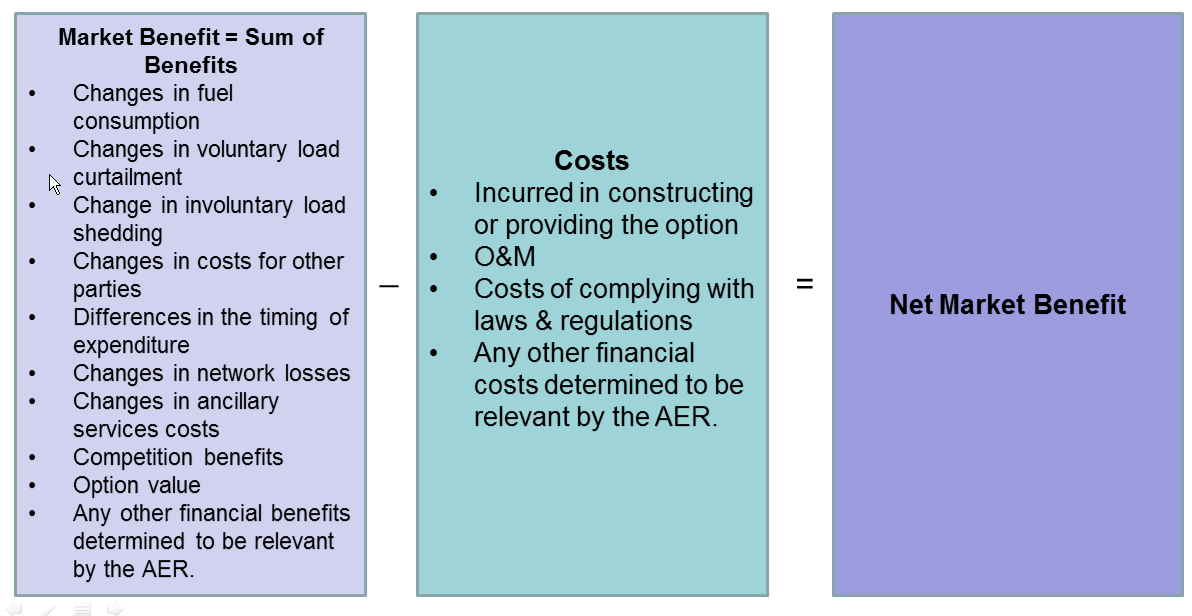
The national framework establishes a nationally consistent annual planning and reporting cycle and project assessment process for distribution networks. It consists of:
Each distribution network service provider (DNSP) is required to undertake an annual planning process covering a minimum forward planning period of five years for its distribution assets (and ten years for dual function assets).
The forward, minimum five year, period commences on a date deemed appropriate by each DNSP.
The planning process applies to distribution network assets and activities undertaken by DNSPs that would be expected to have a material impact on the distribution network in the forward planning period.
In carrying out the planning process, DNSPs are, at a minimum, required to:
DNSPs must publish a Distribution annual planning report (DAPR) setting out the results of the distribution annual planning review for the forward planning period. DNSPs must publish their DAPR by the date specified in jurisdictional electricity legislation or, if no such date is specified, by 31 December. The DAPR must include the information specified in the NER (schedule 5.8 ) .
DNSPs must develop a demand side engagement strategy which sets out the strategy for engaging with non-network providers and considering non-network options for addressing system limitations.
DNSPs must document their demand side engagement strategy in a demand side engagement document which
DNSPs must establish and maintain a demand side engagement facility by which parties can register their interest in being notified of developments related to distribution network planning and expansion .
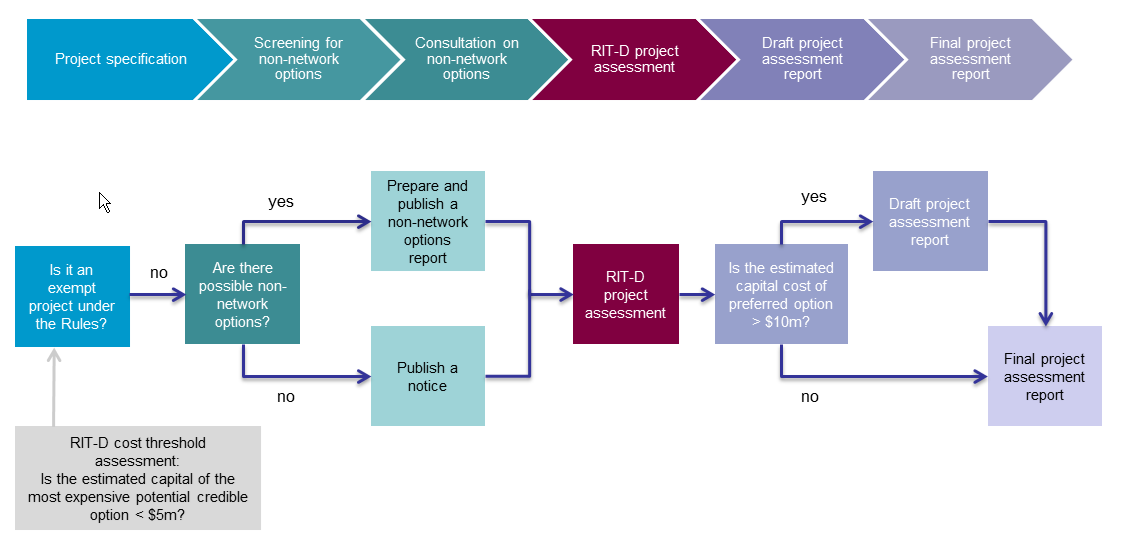
The regulatory investment test for distribution (RIT-D) has two key components:
The non-networks options report consultation includes:
The RIT-D establishes the processes and criteria to be applied by DNSPs in order to identify investment options which best address the needs of the network. It is applicable in circumstances where a network problem exists and the estimated capital cost of the most expensive potential credible option to address the identified need is more than $5 million.
Certain types of projects and expenditure are exempt from the RIT-D, including projects initiated to address urgent and unforeseen network issues.
In summary, the RIT-D requires DNSPs to assess the costs and, where appropriate, the benefits of each credible investment option to address a specific network problem to identify the option which maximises net market benefits (or minimises costs where the investment is required to meet reliability standards).
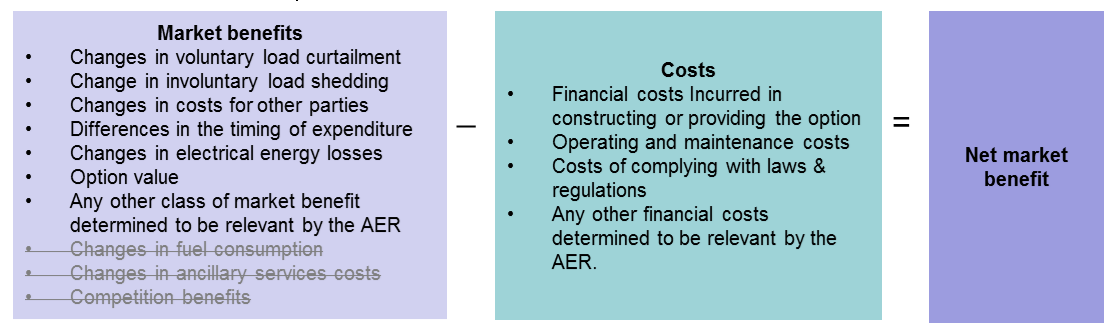
Under the RIT-D, the quantification of market benefits is optional. The NER states that a DNSP may quantify each class of market benefits where it considers that:
However, where a project is not driven by reliability corrective action, a DNSP would need to quantify both the applicable costs and market benefits in order for the preferred option to have a positive net market benefit.
The National Electricity Rules include a dispute resolution process that is open to all projects subject to the RIT-T or RIT-D.
Relevant parties are able to raise disputes with the AER in relation to the conclusions made by the proponent in a final project assessment report, on the grounds that:
The AER may then either reject a dispute, or make a determination on the dispute, and the timeframes for doing so will depend on the complexity of the dispute.
The AER may only make a determination which directs a business to amend its final project assessment report where the business has not correctly applied the RIT in accordance with the rules, or where the business has made a manifest error in its calculations.
There are a number of joint planning arrangements under the National Electricity Rules:
Media Centre Contact
For all media enquiries please email the AEMC Media Manager.
Subscribe
Register to receive AEMC news updates and announcements by email.
Follow Us
Follow the AEMC on LinkedIn for the latest news, events and publications.
Calendar