Media Centre Contact
All Media Inquiries
For all media enquiries please email the AEMC Media Manager.
Natural gas in Australia is currently extracted as either:
Gas producers extract the gas from wells and process it to prepare it for transmission and sale in domestic and overseas markets.
Gas producers sell wholesale gas to electricity generators, other large gas users and energy retailers, who sell it to business and household consumers.
Conventional natural gas:
Shale gas
Unconventional gas:
In 2016 eastern Australia produced 1660 petajoules of gas. Fifty-eight per cent of this was exported from the Queensland LNG facilities. Similarly, most gas produced in Western Australia and the Northern Territory is also exported as LNG.
Conventional natural gas in eastern Australia is currently produced in a number of fields in the Gippsland, Otway, Cooper, Bass and Surat-Bowen basins. Conventional natural gas is also produced from the Carnarvon and Perth basins in Western Australia and the Bonaparte basin in the Northern Territory.
Coal seam gas is produced in a number of fields in the Surat-Bowen and Sydney basins. This gas supplies domestic consumption as well as LNG exports.
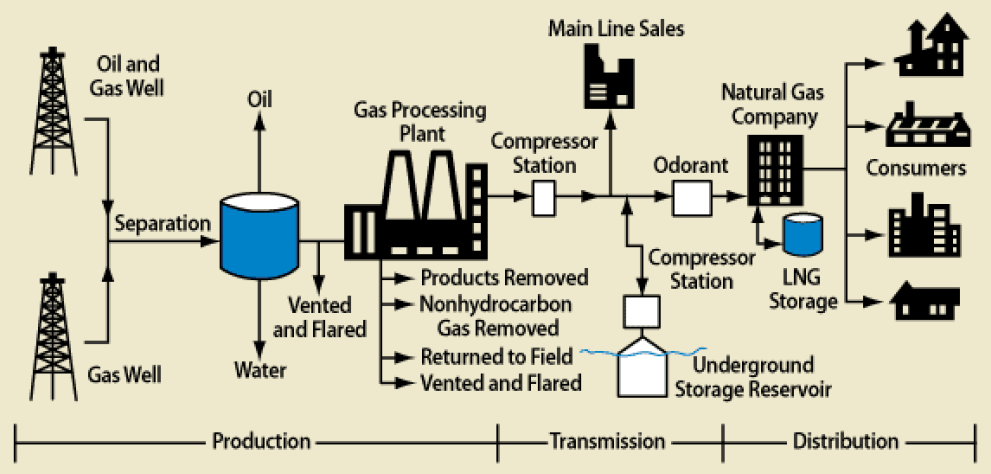
The gas produced for domestic consumption is transported (or ‘shipped’) by high pressure transmission pipelines from the production facility to the entry point of the distribution network (known as the city gate) or to large users that are connected to the transmission pipeline.
Transmission pipelines use very high pressure pipelines, compressor stations, storage facilities and other elements to transport gas.
Storage facilities include any element in the system that has the capability of storing gas, such as:
Gas storage facilities can inject gas into the transmission system at short notice to manage peak demand or emergencies. They are typically owned by energy retailers.
A map of Australian transmission and distribution pipeline can be found on the gas scheme register page.
Gas distribution pipelines transport natural gas from transmission pipelines to end users. They typically consist of a backbone of high and medium pressure pipelines running between the ‘city gate’ (the point of connection to the transmission pipeline) and major demand centres. This pipeline system feeds low pressure pipelines, which deliver the gas to businesses and homes.
Natural gas distribution pipelines supply gas to 4.3 million households and 130,000 commercial and industry customers . There are over 88,000 km of low pressure distribution networks
Energy retailers are the distribution pipelines’ main customers. They buy natural gas in large volumes and on-sell it to consumers.
Media Centre Contact
For all media enquiries please email the AEMC Media Manager.
Subscribe
Register to receive AEMC news updates and announcements by email.
Follow Us
Follow the AEMC on LinkedIn for the latest news, events and publications.
Calendar